Maximum Power Point Tracker (MPPT)
An MPPT is basically an efficient DC to DC converter used to maximize the power output of a solar panel.
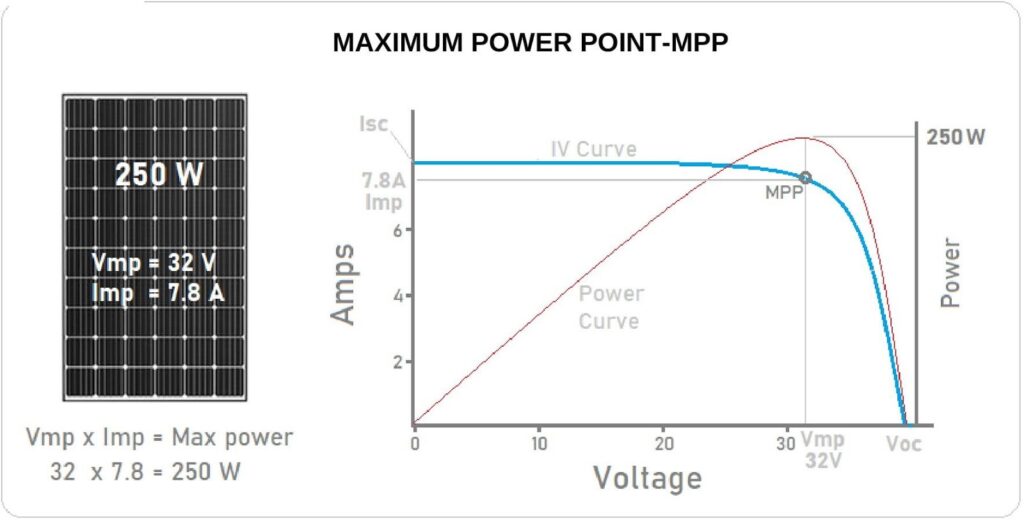
The functioning principle of an MPPT solar charge controller is rather simple – due to the varying degree of sunlight (irradiance) landing on a solar panel throughout the day, the panel voltage and current continuously changes. In order to generate the most power, the maximum power point tracker sweeps through the panel voltage to find the ‘sweet spot’ or the best combination of voltage and current to produce the maximum power.
The MPPT is designed to continually track and adjust the voltage to generate the most power no matter what time of day or weather conditions. Using this clever technology, the solar panel efficiency increases and the amount of energy generated can be up to 30% more than a PWM solar charge controller.
MPPT and PWM solar charge controllers
There are two main types of solar charge controllers, PWM and MPPT, with the latter being the primary focus of this article due to the increased charging efficiency and several other advantages explained in detail below.
Simple PWM, or ‘pulse width modulation’ solar charge controllers have a direct connection from the solar array to the battery and use a basic ‘rapid switch’ to modulate or control the battery charging. The switch (transistor) is open until the battery reaches the absorption charge voltage. Then the switch starts to open and close rapidly (hundreds of time per second) to reduce the current and maintain a constant battery voltage.
This works ok, but the problem is the solar panel voltage is pulled down to match the battery voltage. This in turn pulls the panel voltage away from its optimum operating voltage (Vmp) and reduces power and efficiency.
PWM Vs MPPT
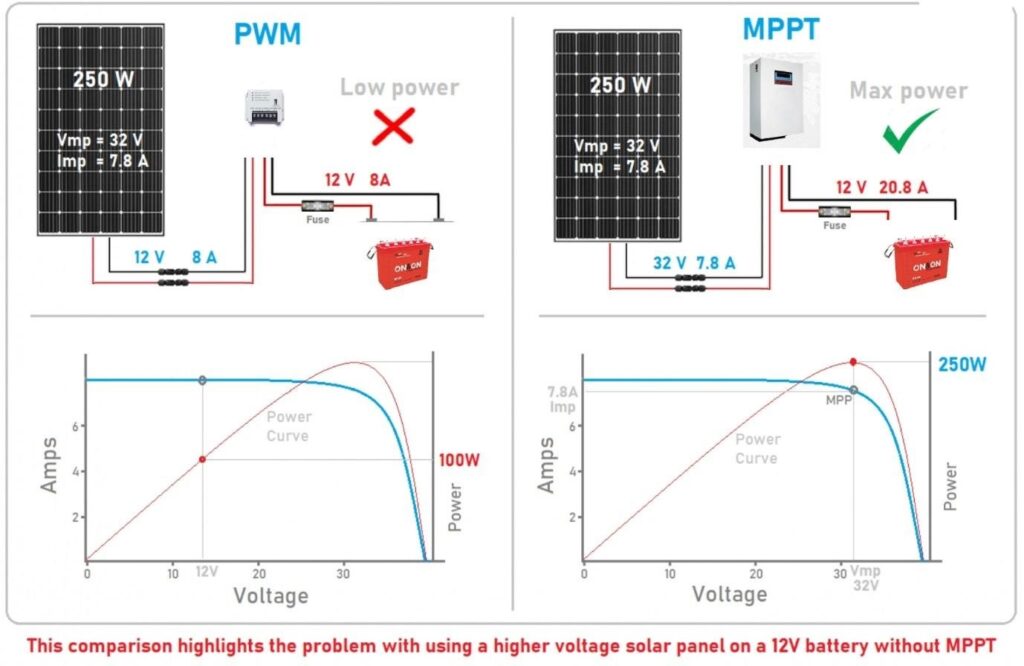 In above example, a common 60 cell (24V) solar panel with an operating voltage of 32V (Vmp) is connected to a 12V battery bank using both a PWM and a MPPT charge controller. Using the PWM controller, the panel voltage must drop to match the battery voltage and so the power output is reduced dramatically.
With an MPPT charge controller, the panel can operate at its maximum power point and in turn can generate much more power.
Battery Voltage
Unlike battery inverters, most solar charge controllers can be used with a range of different battery voltages. For example, most smaller 10A to 40A charge controllers can be used to charge either a 12V or 24V battery, while most larger capacity or higher input voltage charge controllers are designed to be used on 24V or 48V battery systems.
The maximum solar array size which can be connected to the solar charge controller is generally limited by the battery voltage. As highlighted in the following diagram, using a higher 24V battery enables more solar power to be connected to a solar charge controller with a maximum charge rating of 20A.
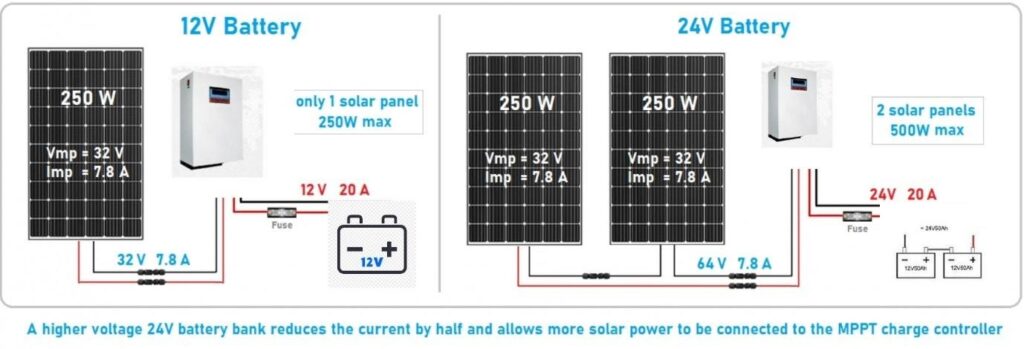
The diagram above shows how a higher 24V battery enables more solar panels to be connected using the same 20A solar charge controller.
Based on Ohm’s law and the power equation, higher battery voltages enable more solar panels to be connected. This is due to the simple formula – Power = Voltage x Current (P=V*I). For example 20A x 12.5V = 250W, while 20A x 25V = 500W.
So using a 20A controller on a higher 24V volt battery, as opposed to a 12V battery, will allow double the size solar array to be connected.
- 20A MPPT with a 12V battery = 260W max Solar recommended
- 20A MPPT with a 24V battery = 520W max Solar recommended
- 20A MPPT with a 48V battery = 1040W max Solar recommended
Note
adding more solar or oversizing the solar array is allowed by some manufacturers to ensure an MPPT solar charge controller operates at the maximum output charge current, provided the maximum input voltage and current is not exceeded!
Solar Panel Voltage Vs Battery Voltage
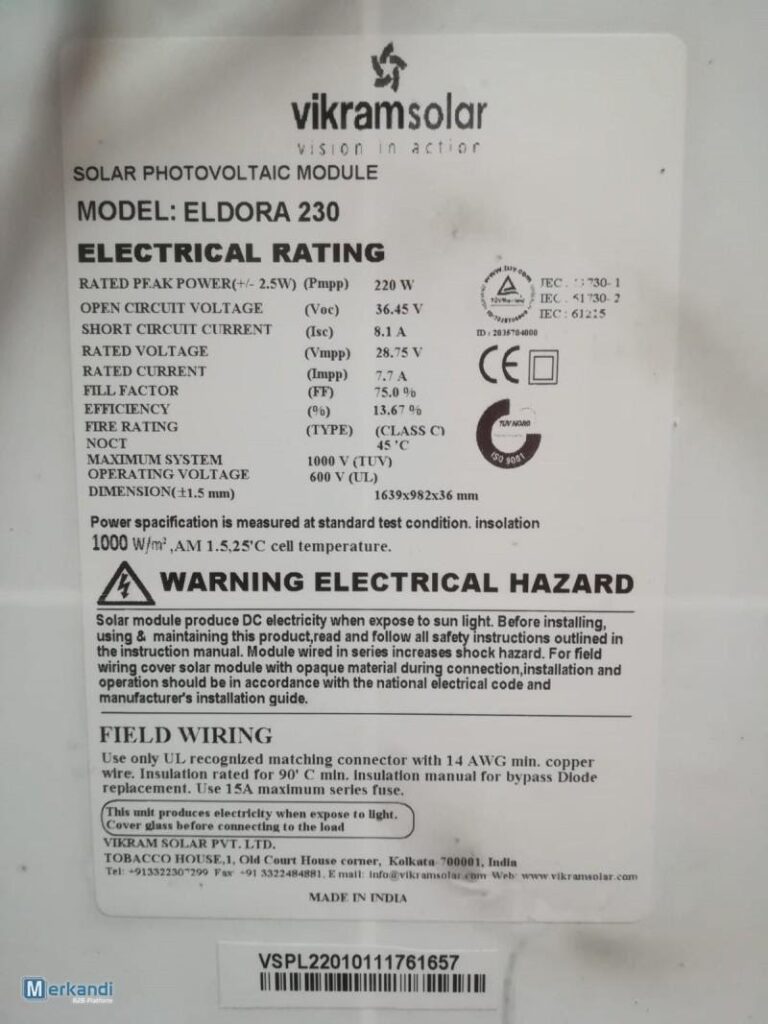
The label on the back of a solar panel should list the panel power, current and voltages (Voc).
For an MPPT charge controller to work correctly the voltage of the solar panel (or solar array) must be at least 4V to 5V higher than the battery ‘charging’ voltage (not the nominal battery voltage).
This is because the panel voltage will drop under cloudy condition or when the solar panel temperature increases. In order for the MPPT to function correctly, the panel voltage must be always higher than the battery voltage under all conditions.
12V Batteries
In the case of 12V batteries the panel voltage drop is not a big problem as most (12V) solar panels operate in the 18V to 22V range, which is much higher than the typical 12V battery charge voltage of 14.4V. Also, common 60-cell (24V) solar panels are not a problem as they operate in the 30V to 40V range.
24V Batteries
In the case of 24V batteries, there’s no issue when 2 or more solar panels are connected in series, but there is a problem when only 1 solar panel is connected. Most common (24V) 60-cell solar panels have a Vmp of 30V to 35V – While this is higher than the battery charging voltage of around 28V, the problem is when the panel temperature increases on a hot day, the panel voltage can drop by up to 6V, and end up below the 28V battery charge voltage, thus preventing it from fully charging. Another way to get around this, when using only one panel, is to use a higher voltage 72-cell or 96-cell panel.
48V Batteries
When charging 48V batteries, the system will typically need at least 2 panels in series but will perform much better with 3 or more panels in series, depending on the maximum voltage of the charge controller. Since most 48V solar charge controllers have a max voltage (Voc) of 150V this allows up to 3 panels to be connected in series.
The higher voltage 250V charge controllers can have strings of 5 or more panels which is much more efficient on larger solar arrays as it reduces the number of strings in parallel and in turn lowers the current.
Note
Panels in series can produce dangerous levels of voltage and must be installed by a qualified electrical professional and meet all local standards.