
How To Select A Hybrid/Off-Grid Inverter?
Modern hybrid & off-grid energy storage systems have many specifications to consider before selecting and sizing an appropriate battery inverter/charger. There are also many different system types now available including all-in-one hybrid solar inverters, complete systems with integrated battery storage (BESS) and AC coupled battery systems.
Here we help explain some the key requirements which should be considered.
- Inverter power output – continuous and surge rating (kW)
- Inverter charge rating (A)
- Solar PV array size (kW)
- Pass through power (A)
- Battery compatibility – System voltage and battery type
- Configuration – AC or DC coupled
- Software and energy management
Inverter Power Output
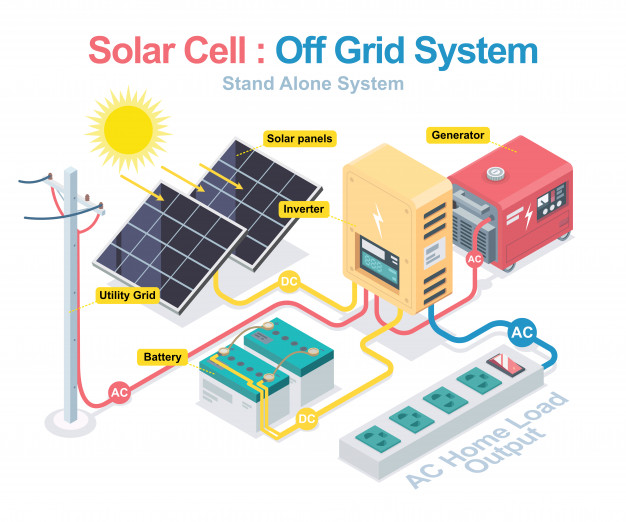
- Off-grid battery inverter/chargers with heavy duty transformers are more expensive but provide very high surge and peak power output and can handle high inductive loads, explained in more detail below.
- Hybrid all-in-one inverter systems and AC coupled battery systems use transformer-less inverters with ‘switching transistors’. These lightweight inverters have lower surge and peak power output capability but are more cost effective being cheaper and easier to manufacture.
Continuous Power Output
Most battery inverters (hybrid or Inverter/charger) are available in a wide range of sizes determined by the continuous output power rating measured in kW.
The inverter should be matched (sized) slightly higher than the load or power demand of the appliances it will be powering. Due to temperature de-rating the inverter should be at least 1.2 times larger than the highest continuous summer demand. Depending on the application this is often the most important specification to be considered when selecting a hybrid inverter especially when using a hybrid inverter as a back-up power source for dedicated or essential loads. Whether the loads are inductive or resistive is also very important and must be taken into account.
For off-grid installations the inverter sizing is critical and must be sized to meet the full load (demand) under all conditions. As mentioned, the temperature derating is especially important as the inverter output is derated (reduced) at higher ambient temperatures, for example a 6kW inverter which is rated and 20degC may only output a continuous power of 4.8kW at 40degC. This de-rating factor must be taken into account, especially in warmer climates.
Surge Or Peak Power Output
The surge or peak power output is very important for off-grid systems but not always critical for a hybrid system. If you plan on powering high surge appliances such as water pumps, compressors, washing machines and power tools the inverter must be able to handle the high inductive surge loads.
Inverter Charge Rating
The battery inverter max ‘charge rating’ measured in Amps needs to be considered to ensure the battery bank capacity and inverter are ‘balanced’ correctly. Ie. ensure the inverter/charger has enough charging capacity to enable the battery to reach the absorption charge voltage.
If the battery bank is too large and inverter charge rating is too small them the battery with not achieve a full charge cycle. This will result in poor performance, degradation and possible sulfation (if lead-acid).
Solar Array Size – Solar PV Input
After sizing the PV array based on the energy consumption profile, location, losses, etc (as calculated by a solar professional) the next step is to determine the maximum solar array size in kW based on the specific hybrid or off-grid system used, which is usually limited by the inverter size.
For off-grid systems the battery capacity (kWh) must also be considered when sizing the solar array.
Compatible Battery Type
Before the release of affordable lithium battery systems most battery inverters were designed to operate with the widely available lead-acid batteries (Gel, AGM & flooded). Lead-acid batteries are far more common but are larger, heavier and can emit gases which require ventilation, whereas lithium-ion batteries are lighter, more compact and are considered safe to store inside a garage. Most lithium battery systems have an integrated battery management system (BMS) which requires an inverter with compatible communications (network protocol) to operate safely and efficiently.
For off-grid systems lead-acid batteries are still a very well proven and reliable technology with a lifespan of up to 10years when sized and managed correctly. One of the biggest benefits of lead-acid batteries is that, unlike modern lithium batteries, they will not shutdown at a low voltage . This is important in emergency situations or when a backup generator fails or is not available.
There are many reliable and well proven lead-acid batteries available for off-grid systems.
Battery Voltage
All hybrid/off-grid inverters are designed to be used with a specific nominal DC battery voltage, small capacity inverters use 12V or 24V so these may only be compatible with lead-acid battery banks of the same voltage.
Note: Unlike the traditional DC coupled solar controllers or regulators, all modern hybrid inverters cannot work with multiple battery voltages.
Battery Capacity – KWh
Battery capacity is measured in kWh (kilowatt/hour) or Amp-hours (lead-acid) is the total amount of energy a battery system can store. However, depending on the battery type and specifications not all of the available capacity is usable.
Common Lead-acid deep-cycle batteries (AGM & Gel) should only be discharged to 20-40% of total capacity, whereas Lithium-ion and new generation battery technologies can be discharged from 80-95%. Therefore the battery chemistry and capacity need to be carefully selected to cater to the user’s energy requirements.
Hybrid Vs Off-grid – For off-grid systems, the battery system will need to be able to store enough energy for several consecutive days of bad weather.
Configuration – AC Or DC Coupled
As solar battery systems became larger and more advanced AC coupled systems evolved as one of the best configurations due to the use of low cost, easy to install string solar inverters. Most modern off-grid AC coupled systems use advanced bi-directional multi-mode inverters coupled with one or more compatible solar inverters.
AC coupled systems are generally more efficient during the day when there is high AC power demand such as air-conditioning systems, modern kitchen appliances and pool pumps.
Software And Energy Management
To enable hybrid or off-grid power systems to optimise energy use and prolong battery life, a high level of power management and battery monitoring is required. The software used to run hybrid/off-grid systems thus require advanced energy management and monitoring capabilities and this is where the high-end Interactive inverters really shine. These powerful inverters have the most advanced software packages with built-in control systems, relays and digital inputs and outputs. These systems also incorporate specialised battery monitoring to prolong battery life and optimise charging when used with lead-acid or VRLA battery banks.
A solar professional should be able to put together what is known as a load table to help determine which type and size inverter is best suited to your individual needs. A detailed load table is also used to size the solar array, battery and backup generator.