Solar Charge Controller
A solar charge controller, also known as a solar regulator, is essentially a solar battery charger connected between the solar panel/s and battery. Its job is to regulate the battery charging process to ensure the battery is charged correctly, or more importantly, not over-charged. DC coupled solar charge controllers, used in almost all small scale off-grid solar power systems.
Modern solar charge controllers have advanced features to ensure the battery system is charged precisely and efficiently, plus functions like DC load terminals for lighting or other DC load requirements. Solar charge controllers are rated according to the maximum input voltage (V) and maximum charge current (A). These two ratings determine how many solar panels can be attached as explained in detail below ‘Sizing a solar charge controller’.
- Current Amp (A) rating = Maximum charging current.
- Voltage (V) rating = Maximum voltage (Voc) of the solar panel/s.
MPPT and PWM solar charge controllers
There are two main types of solar charge controllers, PWM and MPPT, with the latter being the primary focus of this article due to the increased charging efficiency and several other advantages explained in detail below.
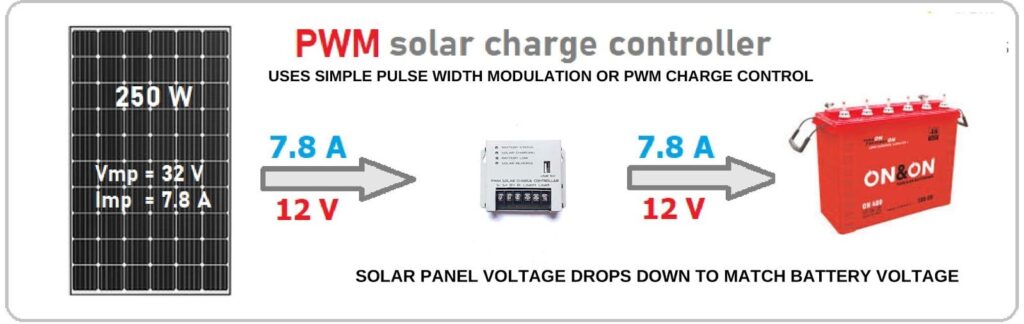
Simple PWM, or ‘pulse width modulation’ solar charge controllers have a direct connection from the solar array to the battery and use a basic ‘rapid switch’ to modulate or control the battery charging. The switch (transistor) is open until the battery reaches the absorption charge voltage. Then the switch starts to open and close rapidly (hundreds of time per second) to reduce the current and maintain a constant battery voltage.
This works ok, but the problem is the solar panel voltage is pulled down to match the battery voltage. This in turn pulls the panel voltage away from its optimum operating voltage (Vmp) and reduces power and efficiency.
MPPT Solar Charge Controllers
MPPT or ‘maximum power point tracking’ controllers are far more advanced than PWM controllers and enable the solar panel to operate at its maximum power point, or to be more precise, the optimum voltage for maximum power output.
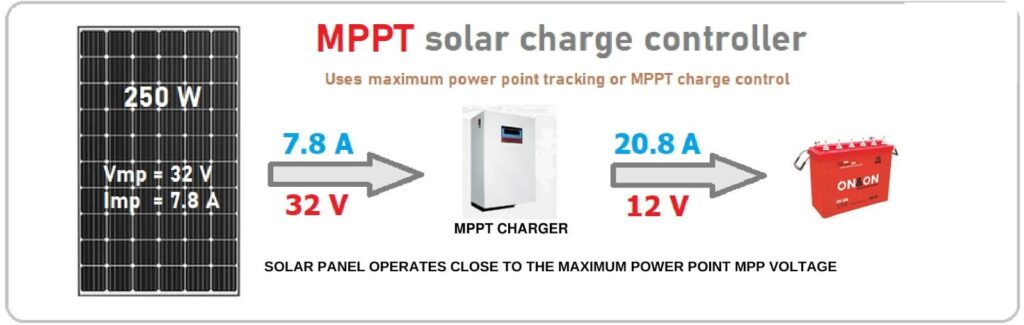
Using this clever technology, MPPT solar charge controllers can be up to 30% more efficient, depending on the battery voltage and voltage of the solar panel connected. As a general guide, MPPT charge controllers should be used on all higher power systems using 2 or more solar panels, or whenever the panel voltage (Vmp) is 8V or higher than the battery voltage