Battery
Battery Types
There are 3 types of inverter batteries
- Tubular Battery
- Gel Battery
Tubular Battery
A tubular battery is a lead-acid battery that is generally big in size when compared to a flat plate battery. These best inverter batteries are suited for areas with long and fewer power cuts.
Why should you choose a Tubular battery?
Tubular batteries are best fitted for long power backup requirements and have a longer service life. These batteries require minimum effort to maintain and need fewer water top-ups. They are more reliable and usually come with a longer warranty period compared to a flat plate battery. A tubular battery is more expensive and takes more space to store than a flat plate battery.
Tubular batteries come in various container sizes, and it should be selected based on the space available in the house to store the inverter battery. Also, the tubular battery price is affordable.
Tall tubular inverter battery is larger in height than a short tubular battery and a flat plate battery but lesser in width. A tall tubular battery always provides a slightly longer backup time and is preferred for homes where storage space is not a constraint.
Gel Battery
Gel batteries give a more consistent power backup over a longer period than a normal lead-acid battery as it has a special crisscross structure of gel inside them that holds the acid and prevents it from settling down. They also offer more power backup per cycle.
Gel battery comes at a higher price than a tubular lead-acid battery, then why should you choose a gel battery?
The biggest advantage of a gel battery is that it is environment friendly and emits minimal harmful gas into the atmosphere making your home/office a healthier place. It is also sealed due to which there is zero risk of acid spillage. This best inverter battery is also easy to install and maintenance-free.
No water top-up is required during the entire lifecycle of these batteries. The cost of battery for inverter is decreasing day by day, and hence the importance is increasing rapidly. Lastly, these inverter batteries provided consistent power backup throughout its life, unlike normal lead-acid batteries, where power backup reduces after a certain no. of years.
Recommended: Tubular Battery
How to Choose Battery
A battery is a critical part of an inverter. An inverter’s output and life largely depend on its battery.
The first thing you should understand before buying an inverter battery for home or office is your power requirement. There are two important factors determine your power backup requirement, based on which you should decide what capacity of the battery is suitable for your need.
- Duration of continuous power backup, i.e., on an average, how long there is no electricity at your home or office
- Load that you want to run at the time of power cut
Accordingly, you can decide the ampere-hour (Ah) rating of the inverter battery for your purchase. Please note that the inverter battery’s capacity varies with the above 2 factors, the load and the duration of power backup. The more is the load and more is the duration of power backup, higher will be the battery capacity.
Other Factors to Be Considered Before Selecting Battery Capacity
You can find inverter batteries with various capacities in the market ranging from 80 Ah to 230 Ah.
So how do you decide which one is best suited for your requirement?
Based on the factors mentioned above, you can choose a battery with capacity that is perfect for your requirement.
Please note that the inverter Battery Voltage rating is 12 V for almost all inverter batteries available in the market. As the load increases, the inverter wattage increases accordingly. Higher inverter capacity runs at a higher voltage in multiple of 12V, i.e. 24 V, 36 V, etc. A 24 V inverter requires 2 batteries of 12 V each.
What are the other factors to be considered while buying a battery?
The main points that need to be considered while buying a battery are capacity, warranty, technology, and size. When buying a new inverter battery, we suggest you to purchase a battery with the highest Ah rating and warranty possible. Physical size and technology must also be taken into consideration.
Please ensure that you purchase the best inverter battery best suited for your requirement, from a renowned brand to ensure good product quality and service.
Apart from the above parameters, the freshness of a new inverter battery is also very important. The performance of a battery deteriorates if it does not go through a regular charge/discharge process.
How To Calculate Inverter Battery Capacity: The Formula
The formula to calculate the capacity of an inverter battery is simple formula and here it is:
Battery Capacity = Total Load In Watts X Usage time (in hours) / Input voltage
Total Load (in watts):
This is the total load your inverter battery will be able to carry. The more capacity your battery has, the more load it will be able to carry for long hours.
So, it comes down to the number of appliances you want to power with your inverter.
As an example, let’s assume you want to power, 5 lights of 20 watts,1 no 100 watts TV,1computer with 200watts and 2 fans of 80 watts each. Total load in this case will be:
5*20+1*100+1*200+2*80 = 560 Watts
Hence, the load on inverter will be of 560 watts.
Usage Time (in hours)
This simply means, how long do you want the battery to last when there is a power shutdown. You can estimate this by calculating the average time of power cut your area gets.
For example, usually if power cuts in your area are 2 hours long, that means that you would usually need a power backup of 2 hours.
Input Voltage
This simply means the voltage of the battery. In India, almost all the inverter batteries have 12V of the input voltage. However, some inverters have 24V of input voltage too.
The Calculation:
- Total Load: 560 Watts
- Usage Time: 2 Hours
- Input Voltage: 12V
560 X 2/12 = 93.3 Ah
Therefore, in this case a battery of near 100AH capacity should serve good.
Calculate How Many Hours Your Inverter Battery Would Last
The capacity of your battery and the load you put on it will determine how long your battery will last after every charge.
For example, if your battery is 100AH and you put 100A of load on it, it would last for around 1 hour. If you put 10A of load, it would last for 10 hours.
Example:
So, let’s take an example to understand it better.
Let’s assume, you have 2 lights of 40 watt each and 2 fans of 75 watts each and you have an inverter with a 150AH of capacity.
Load of appliances:
- 5 Lights = 20 x 3 = 60 watts
- 2 fans = 80 x 3 = 240 watts
Total Load = 60 + 240 = 300 watts
Input Voltage = 12V
Load on inverter battery = 300/12 = 25 Amp
Inverter Battery Capacity = 100 AH
Estimated hours = 100/25 = 4 Hours
Approximate 80% of the time will be the back up time ie.3.2hrs.
Steps To Increase Inverter Battery Life
Quick tips for maintenance and handling
- Do not expose the battery to direct sunlight.
- Keep the battery away from heat, in a dry, cool, and ventilated space.
- Keep the battery out of the reach of children.
- Keep checking the float indicators in the battery time to time, add water top-up when required.
- Do not fill acid into the battery.
- Do not keep the battery water indicators open.
- Always get the service done by authorized service personnel only and never by a local technician.
- Be a responsible citizen. never discard the non-functional batteries into dustbins, roads, or anywhere else.
Whenever you check your inverter battery, follow these 3 steps to ensure good health of the battery. Checking these aspects should take just 10-15 minutes of your time.
Ensure that battery terminals are clean
The battery terminals should always be clean. If you find something fishy with the battery terminals, you might need to contact the support team of the company.
Clean the battery surface
The battery surface gets dirt from time to time. Make sure you clean it with a soft cotton cloth. Keep it as clean as possible.
Check water level of the battery every 30-40 days
The water level of the battery should not go below the minimum limit. My recommendation would be to check every 30-40 days and ensure that the water level is above the minimum limit.
Tips To Improve Your Inverter Battery’s Life Like
Here are some tips that you should keep in mind to ensure better battery life:
- Always keep the battery in an open and airy space. This will help it dissipate the heat with easy and hence keep it as cool as possible.
- Keep the battery away from any type of heat, fire, smoke, etc. Protect it from catching fire to avoid accidents.
- Top-up the water with distilled water only. Don’t use tap water as it has impurities that will affect badly.
- Make sure the battery is in use. If there are not enough power cuts in your area, you may completely discharge it and recharge it again every month.
Useful Tips on Maintaining Your Inverter Battery
My inverter battery doesn’t last long anymore
This is a popular complaint from users of power backup systems.
The inverter is an electronic device that converts Direct Current (DC) to Alternating Current (AC). The battery is the live-wire of an inverter. The lifespan of a battery depends mainly on its usage and maintenance. All batteries require some form of maintenance to maintain their lifespan.
To enjoy your inverter, your batteries must be well taken care of. But most people don’t know how to go about doing that. Below are useful tips on how to take care of your batteries:
- Make sure the inverter battery is installed in a well-ventilated area. This reduces the heating up of the battery thereby maintaining its lifespan.
- Even if there is no power outage, make sure your batteries are still used by discharging them at least once a month.
- Keep your battery away from fire and smoke.
- Ensure proper loading of devices. Do not connect loads greater than what the inverter was designed to carry.
- Disconnect extra load when not in use.
- Use energy-saving devices on the power backup system.
- If a battery is damaged, replace it. Do not combine old and new batteries together in a system. Routine maintenance will help you know about changes to be made with respect to your inverter and battery.
- Allowing the power in the battery to drain completely frequently before recharging it damages the inverter battery’s cells. This reduces its lifespan.
Effect of Temperature on Battery
The working performance, lifespan, voltage and chemical reactions of a battery can be affected by temperature — hot or cold. The effect of temperature on a battery is dependent on the technology and design of the battery.
The general optimal operating temperature of some batteries, e.g Lead-acid batteries is about 25°C (77°F). Therefore, your battery will discharge at a normal rate when stored at this temperature. The hotter a battery, the faster chemical reactions will occur.
Although the high temperatures sometimes cause increased performance of the batteries, they will result in faster discharge and a corresponding loss of battery life. At temperatures below the normal operating normal temperature, 25°C (77°F), batteries have a decreased capacity and longer life.
According to Battery University, each 8°C (15°F) rise in temperature cuts the life of a sealed lead acid battery in half. As a rule of thumb, for every 10°C increase in temperature the reaction rate doubles. Thus, a month of operation at 35°C is equivalent in battery life to two months at 25°C.
Important things to note while siting your battery bank location
Here are relevant steps you should note while sitting where your batteries will be kept in order to ensure optimum performance:
- Keep your batteries away from direct sunlight or sources of heat.
- Keep your batteries in racks. Why? Keeping them on the ground usually lowers their temperature.
- Install your batteries in well-ventilated areas for optimum performance.
- For a large battery bank, a cooling system can be used with a temperature sensor that maintains the room temperature at 25°C (77°F) all the time.
Important things to note while siting your battery bank location
Here are relevant steps you should note while sitting where your batteries will be kept in order to ensure optimum performance:
- Keep your batteries away from direct sunlight or sources of heat.
- Keep your batteries in racks. Why? Keeping them on the ground usually lowers their temperature.
- Install your batteries in well-ventilated areas for optimum performance.
- For a large battery bank, a cooling system can be used with a temperature sensor that maintains the room temperature at 25°C (77°F) all the time.
What is Depth of Discharge and how does it affect the lifespan of batteries?
Batteries are fast becoming an important part of off-grid and hybrid systems. There are numerous factors that affect the lifespan of a battery
What is Depth of Discharge?
Depth of discharge (DoD) simply refers to the degree to which a battery is discharged in relation to its total capacity. When a battery discharges completely, its Depth of Discharge is 100%. If you have a battery that holds 4kWh and you discharge 2.8kWh, the Depth of Discharge is 70%.
The battery life or lifespan is dependent on how deep a battery is cycled each time. A battery ‘cycle’ is one complete discharge and recharge cycle. A battery completes a cycle life when it discharges 100%. Therefore, If a battery is discharged to 50% and recharged, it has completed half cycle. Discharging it to 50% again and recharging it again results in one complete cycle — 100%.
A battery may have 10,000 cycles at 10% DoD but only 2000 cycles at 80% DoD. A battery that is drained to 30% DoD daily will have a longer lifespan than one that is frequently drained to 80% DoD. Frequent charge and discharge of batteries shorten their lifespan.
Most battery manufacturers indicate in the specification sheet the maximum recommended DoD for peak performance of the battery. If the manufacturer of a 10 kWh battery recommends a maximum DoD of 50%, it means that you should avoid discharging more than 5kWh without recharging.
Batteries are the most common energy storage systems used in solar and off-grid systems. Here are some basic Do’s and Don’ts you should note about using them.
Do’s
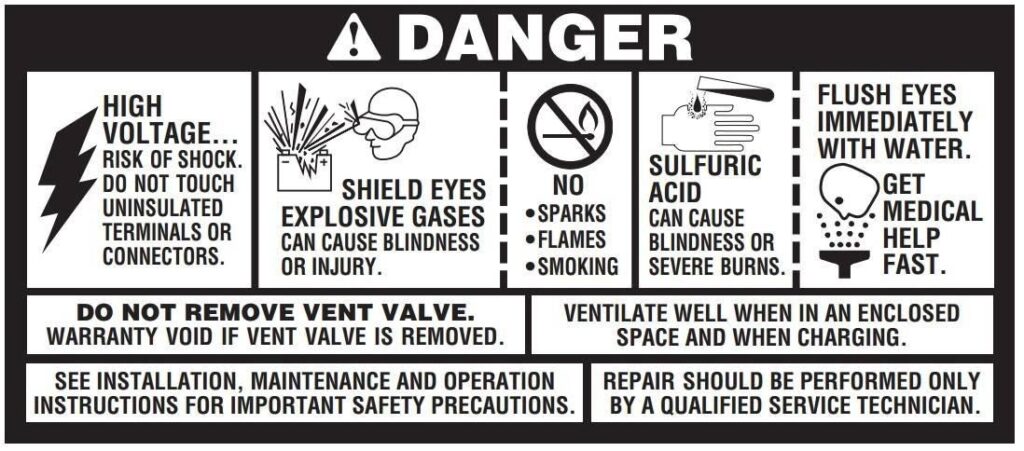
- Think Safety First! Batteries are safe. Nevertheless, caution should be taken when handling them. One should use the right Personal Protective Equipment (PPE). Why? The contents of batteries can pose as health hazards if not properly handled.
- Ensure that the surface and surrounding of your battery is always kept clean and free of dirt.
- Have regular inspection and maintenance of your battery done by professionals.
- Recharge your batteries immediately after discharge. Even in times where batteries are unused, recharge them at least once a month to maintain its efficiency.
- Ensure that the required and adequate size and ratings of cables recommended for the battery are used during installations.
- Ensure proper disposal of used batteries. How? Return it to the vendor you acquired it from or take it to a certified battery recycler.
Don’t
- Do not combine old and new batteries in a system as this will affect the performance of the new batteries negatively.
- Don’t use any type of water to refill your batteries. Use only DISTILLED WATER so as not to contaminate the electrolyte.
- Do not combine different types and sizes of batteries in one system. Don’t discharge a battery any deeper than you possibly have to.
Why your power backup system does not last as long as it should
“My power backup system is not lasting as long as it should.”
“My batteries are just a few months old and they last for a very short period.”
If the above sentences sound like what you’ve said, then you should know the reasons why your power backup system isn’t serving you well. They are:
Poor Design
Before installation, a load/energy audit is important. During the audit, the electrical energy demand of the appliances in your home or office is assessed. If this isn’t done, there’s a great possibility your system won’t last as long as expected
If the load on a system is greater than the battery capacity, the batteries will drain faster than normal.
Deep discharge of batteries
When you drain your battery below the required Depth of Discharge, the cycle life reduces. They wouldn’t last for as long as they were designed to.
Temperature
Batteries discharge faster at high temperatures. Ensure that your power backup solution is installed in a well-ventilated area. Constantly exposing the system to high temperatures reduces its lifespan.
Every battery manufacturer has a temperature range of their batteries. This is usually stated in the operating manuals or user guide. Installers should take note of this.
Our recommendation
ON&ON TUBULAR BATTERIES are robust and proven tubular plate technology batteries, ideal for use in all standby, deep cycling and shallow cycling applications that require high levels of reliability. They are designed and manufactured according to relevant standards.
Tubular Batteries are assembled with tubular positive and pasted negative plates made of a special alloy. They are provided with transparent sealed float indicators and Micro Porous Aqua Trap vent plugs, which allow generated gases to escape and traps water particles, returning the major portion to the electrolyte.
This reduces the frequency of topping up. With extra electrolyte head and proper voltage control, the frequency of topping up will be once a year. For the available series of Tubular Batteries please refer the types.
PRODUCT FEATURES
- Batteries are designed to withstand frequent and long power cuts
- Assembled in polypropylene containers with plate holding cradles
- Extra thick tubular plates
- Thick tubular plate spines are of low antimony alloy for super fine grain structure and minimized grid corrosion at high temperatures
- Negative plates are of low antimony alloy
- Micro porous ceramic vent cum sealed float plugs to reduce topping up frequency
- Resistance to corrosion and high ambient temperature
- Low self discharge
- Deep cycle design